
Tree Carbon Calculator
Estimate the carbon stored in a tree and its approximate CO₂ equivalent using simple tree measurements.
Trees naturally store carbon as they grow, locking it into their trunks, branches, and other woody tissues. But the amount can vary widely depending on the tree’s size, species, wood density, and overall structure. Our Tree Carbon Calculator gives you a simple estimate of carbon stored in a tree, above-ground biomass, and CO₂ equivalent using basic tree measurements.
If you enjoy understanding your garden through numbers, you can explore more practical plant and tree calculators on Grow Plants Easy for easier planning and everyday tree care.
🌿 What Is a Tree Carbon Calculator?
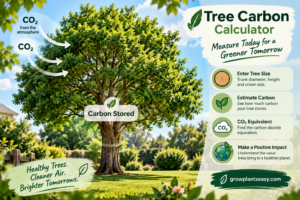
A Tree Carbon Calculator is a simple tool designed to estimate how much carbon may be stored in a tree’s above-ground woody biomass.
Instead of weighing an entire tree, the calculator uses measurements such as trunk diameter (DBH), tree height, and estimated wood density. It then applies simplified assumptions to estimate biomass and the amount of carbon contained within it.
The result should be treated as an approximation, since actual tree biomass can differ substantially between species and individual trees.
Check: Tree Weight Calculator & Tree Canopy Calculator
📏 How to Use the Tree Carbon Calculator
1. Measure the Trunk Diameter
Measure the tree’s diameter at breast height (DBH), approximately 4.5 feet or 1.37 meters above ground level.
You can enter the measurement in inches or centimeters.
2. Enter the Tree Height
Estimate the total height of the tree and select either feet or meters. A more accurate height measurement can improve the usefulness of the estimate.
3. Choose Wood Density
Select the wood-density range that most closely represents your tree. Different species can have very different wood densities, so this input can noticeably affect the result.
4. Select the Crown Size
Choose whether your tree has a small, average, large, or very large crown. The calculator uses this as a simple adjustment for branches and other above-ground woody biomass.
5. Calculate Carbon Storage
Click Calculate Tree Carbon to see estimated:
- Above-ground biomass
- Stored carbon
- CO₂ equivalent
- Trunk volume
📊 Tree Carbon Measurements Explained
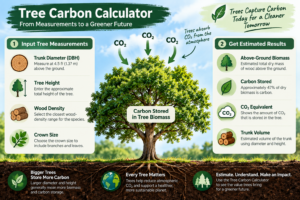
| Measurement | What It Means |
|---|---|
| DBH | Diameter of the trunk measured around 4.5 ft (1.37 m) above ground |
| Tree Height | Approximate total height of the tree |
| Wood Density | Approximate dry mass of wood per unit of volume |
| Above-Ground Biomass | Estimated dry woody biomass above the soil |
| Stored Carbon | Estimated carbon contained in that biomass |
| CO₂ Equivalent | Amount of CO₂ corresponding to the estimated stored carbon |
Also check: Grow Light Calculator & Cubic Yards of Dirt Calculator
🧮 How Is Tree Carbon Estimated?
The calculator first estimates the volume of the trunk using its diameter and height. Because a tree trunk tapers rather than remaining a perfect cylinder, a form factor is applied to reduce the full cylindrical volume.
The estimated volume is then combined with the selected wood density to approximate dry trunk biomass. An additional adjustment accounts for branches and crown biomass.
For this simplified calculator, approximately 47% of estimated dry biomass is treated as carbon.
❓ Frequently Asked Questions
How much carbon does a tree store?
There is no single amount that applies to every tree. Carbon storage depends on species, size, wood density, age, crown structure, and growing conditions.
What does DBH mean?
DBH means diameter at breast height. It is a standardized way of measuring tree trunk diameter, commonly taken at approximately 4.5 feet or 1.37 meters above ground.
Is stored carbon the same as CO₂?
No. Carbon is an element contained in tree biomass, while CO₂ is carbon dioxide. The calculator therefore displays stored carbon and its corresponding CO₂ equivalent separately.
Does the calculator include tree roots?
No. This calculator focuses on an estimate of above-ground woody biomass. Root biomass and soil carbon are not included.
Is the Tree Carbon Calculator accurate?
It provides a simplified estimate for general and educational use. Professional carbon assessments generally use species-specific allometric biomass equations and may account for roots, local growing conditions, and other factors.
🏁 Final Thoughts
A Tree Carbon Calculator offers an interesting way to understand the relationship between tree size, biomass, and carbon storage. By entering the tree’s DBH, height, wood density, and crown size, you can get a quick estimate of its above-ground biomass, stored carbon, and CO₂ equivalent