
🌱 Mowing Time Calculator
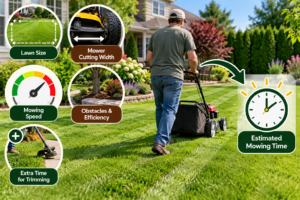
Wondering how long it will take to mow your lawn? Our Mowing Time Calculator estimates your mowing time using lawn size, mower cutting width, mowing speed, efficiency, and extra time for obstacles. It also calculates acres per hour, square feet per hour, base mowing time, and approximate mowing passes.
Whether you use a push mower, riding mower, or zero-turn mower, this tool can help you plan your lawn-care time. You can also explore our easy lawn and garden calculators for other outdoor projects.
🚜 How to Use the Mowing Time Calculator
Using the calculator is simple:
- Enter your lawn area.
- Choose square feet, acres, square meters, or hectares.
- Enter your mower cutting width.
- Add your average mowing speed.
- Select the mowing efficiency based on your lawn.
- Add extra time for trimming, obstacles, or difficult areas.
- Optionally enter your lawn length to estimate mowing passes.
- Click Calculate Mowing Time.
The calculator will instantly estimate how many minutes or hours your mowing job may take.
Check: Sprinkler Coverage Calculator & Lawn Mowing Cost Calculator
⏱️ How Is Mowing Time Calculated?
The calculator considers how much ground your mower can theoretically cover and then adjusts that figure for real-world mowing conditions.
A wider mower and higher mowing speed generally increase the amount of lawn you can cover each hour. However, turns, overlapping passes, trees, flower beds, slopes, and other obstacles reduce actual mowing efficiency.
Typical Mowing Speeds
| Mower / Mowing Style | Approx. Speed |
|---|---|
| Slow Push Mowing | 2–2.5 mph |
| Typical Walk-Behind Mower | 2.5–3.5 mph |
| Riding Lawn Mower | 3–5 mph |
| Zero-Turn Mower | 4–7+ mph |
These are only general estimates. Your actual speed depends on the mower, grass conditions, terrain, and operator.
Also check: Peat Moss Calculator & Landscape Lighting Calculator
🌿 What Affects Lawn Mowing Time?
Mower Cutting Width
Cutting width has a major effect on mowing time. A 42-inch riding mower covers a wider strip with every pass than a small walk-behind mower, reducing the number of passes needed.
Lawn Size
Larger lawns naturally require more mowing time. Measuring your lawn accurately helps produce a more useful estimate.
Trees and Landscaping
Trees, garden beds, fences, pathways, playground equipment, and other obstacles require additional turns and maneuvering. Select a lower efficiency level when your lawn contains many obstacles.
Lawn Terrain
Flat, open lawns are usually quicker to mow. Slopes, uneven ground, wet areas, and tight spaces may require slower mowing speeds.
❓ Mowing Time Calculator FAQs
1. How long does it take to mow a lawn?
It depends on the lawn size, mower width, mowing speed, and obstacles. A small open yard may take only a short time, while several acres can require hours. Use the calculator for an estimate based on your specific setup.
2. How long does it take to mow an acre?
There is no single time for every mower. A wider riding or zero-turn mower can generally cover an acre much faster than a narrow push mower. Mowing speed and lawn complexity also make a significant difference.
3. Does a wider mower reduce mowing time?
Generally, yes. A wider cutting deck covers more ground during each pass, which can reduce the total number of passes. However, very large mowers may be harder to maneuver in small or heavily landscaped yards.
4. Why does the calculator include mowing efficiency?
Turns, overlapping passes, slowing around obstacles, and other interruptions prevent a mower from operating at maximum capacity continuously. The efficiency setting makes the estimate more realistic.
5. Can I calculate acres mowed per hour?
Yes. The calculator estimates acres per hour using mower cutting width, mowing speed, and efficiency. This can be useful for homeowners, landscapers, and lawn-care professionals comparing different mowing setups.
🌱 Final Thoughts
The Mowing Time Calculator makes it easy to estimate how long a lawn may take to mow before you start.
Enter your lawn size, mower width, mowing speed, and lawn conditions to estimate mowing time, mowing capacity, acres per hour, and passes. For the best estimate, use realistic mowing speeds and choose an efficiency level that matches your actual yard.