
🍃 Tree Leaves Calculator
Estimate the approximate number of leaves on a tree using canopy size, average leaf size, and leaf density.
Have you ever wondered how many leaves are actually growing on a tree? 🌳 Counting them one by one would take an enormous amount of time, especially for a mature tree with a large canopy.
Our Tree Leaves Calculator provides a practical estimate using the tree’s canopy size, average leaf dimensions, and canopy density.
Explore more plant and tree calculators on Grow Plants Easy to estimate tree size, age, leaf count, spacing, and other gardening measurements.
It won’t give an exact botanical leaf count, but it can provide a useful approximation for gardening projects, educational activities, nature studies, and simple tree comparisons.
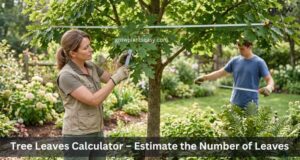
🌿 How to Use the Tree Leaves Calculator
The calculator needs a few simple measurements:
- Canopy length
- Canopy width
- Measurement unit
- Average leaf length
- Average leaf width
- Leaf density
After entering these values, the calculator estimates:
- 🍃 Approximate number of leaves
- 🌳 Canopy area
- 📏 Average leaf area
- 📊 Canopy density
- 🍃 Estimated low-to-high leaf range
The more realistic your measurements are, the more useful the estimate will be.
Check - Estimate the Age of a Tree & Tree Height Calculator
🌳 What Does a Tree Leaves Calculator Measure?
A tree can contain thousands or even millions of individual leaves depending on its species and size.
Because directly counting every leaf isn’t practical, this calculator uses an estimation approach.
It considers the approximate area covered by the tree canopy and compares that with the estimated surface area of an individual leaf.
Canopy density is then used to adjust the result for trees with relatively sparse or dense foliage.
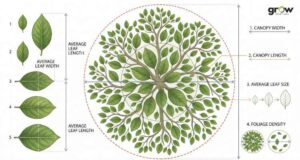
📐 How Is the Number of Leaves Estimated?
The calculator treats the tree canopy approximately like an ellipse.
The basic canopy-area calculation is based on:
Canopy Area ≈ π × (Canopy Length ÷ 2) × (Canopy Width ÷ 2)
The approximate area of an individual leaf is then estimated from its length and width.
The calculator combines these measurements with a leaf-density factor to produce an approximate leaf count.
Because real trees aren’t perfect geometric shapes, this should be viewed as an estimation rather than an exact scientific measurement.
🌿 Choosing the Right Leaf Density
The calculator includes four density options.
| Canopy Density | Description |
|---|---|
| Sparse | Large gaps between leaves and relatively open foliage |
| Average | Typical healthy canopy |
| Dense | Thick foliage with fewer visible gaps |
| Very Dense | Extremely full and closely packed foliage |
Choosing the right density is important because two trees with the same canopy dimensions can have very different amounts of foliage.
Also check: Oak Tree Age Calculator & Pergola Post Size Calculator
🌳 Leaf Count Can Vary by Tree Species
Different tree species have very different foliage patterns.
For example:
| Tree Type | Typical Leaf Character |
|---|---|
| Oak | Broad leaves with a relatively open canopy |
| Maple | Broad leaves and often dense foliage |
| Birch | Smaller leaves with lighter canopy structure |
| Pine | Needle-like foliage rather than broad leaves |
| Mango | Long, broad evergreen leaves |
| Neem | Numerous smaller leaflets |
| Apple | Medium-sized broad leaves |
These differences make it difficult to create one universal leaf-count formula for every tree.
The calculator is therefore best used as a general estimation tool.
❓ FAQs – Tree Leaves Calculator
1. How many leaves does a tree have?
There is no single number. Leaf count depends on species, tree size, canopy density, leaf size, season, and growing conditions. A mature tree can have thousands or potentially millions of leaves.
2. Can I calculate the exact number of leaves on a tree?
Not with this calculator. It provides an approximate estimate based on canopy size, leaf dimensions, and density.
3. What measurements do I need?
You need the approximate canopy length, canopy width, average leaf length, average leaf width, and canopy density.
4. Why does leaf size affect the result?
A tree with small leaves can contain many more individual leaves within a similar canopy area than a tree with large leaves.
5. How do I measure tree canopy width?
Measure across the canopy from one outer edge to the opposite edge. For irregular trees, measurements from several directions can be averaged.
🌳 Conclusion
The Tree Leaves Calculator offers a simple way to estimate how many leaves a tree may have without attempting to count them individually.
By combining canopy size, average leaf size, and foliage density, you can get a useful approximation of the tree’s potential leaf count.
Remember that trees are living organisms, not perfect geometric shapes. Leaf numbers change with species, season, weather, growth, and health, so the calculator’s result should be treated as an estimate.
Still, it’s a fun and useful way to explore just how much foliage can be packed into a single tree. 🍃🌳