
🌲 Basal Area Calculator
Calculate the basal area of a tree or estimate total stand basal area using tree diameter and the number of trees per acre.
The size of a tree isn’t measured only by its height or canopy. Basal area is another important measurement used in forestry to understand how much cross-sectional area tree trunks occupy within a forest or woodland.
Our Basal Area Calculator makes this calculation simple. Enter a tree’s diameter at breast height (DBH) to calculate the basal area of an individual tree. You can also switch to the Forest Stand option to estimate basal area per acre based on average tree diameter and tree density.
Explore more plant and tree calculators on Grow Plants Easy to calculate tree size, age, spacing, basal area, and other useful measurements.
Whether you’re learning about forestry, managing woodland, or simply exploring tree measurements, this calculator provides a quick estimate.
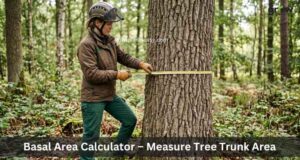
📏 What Is Basal Area?
Basal area is the cross-sectional area of a tree trunk at a standard measurement height, usually 4.5 feet (1.37 meters) above the ground.
It is normally calculated from the tree’s DBH (Diameter at Breast Height).
Basal area is usually expressed in:
- Square feet per tree
- Square meters per tree
- Square feet per acre for forest stands
A tree with a larger trunk has a greater basal area than a tree with a smaller trunk.
Check - Tree Leaves Calculator & Tree Diameter Calculator
🌳 How to Use the Basal Area Calculator
The calculator has two options.
Single Tree
Choose Single Tree when you want to calculate the basal area of one tree.
Enter:
- Tree DBH
- Diameter unit
The calculator returns the tree’s basal area in square feet and square meters.
Forest Stand
Choose Forest Stand when you want an estimate for a group of trees.
Enter:
- Average tree DBH
- DBH unit
- Number of trees per acre
- Number of trees in your measured plot
- Plot area
- Plot area unit
The calculator then estimates basal area per acre and total basal area for the measured group.
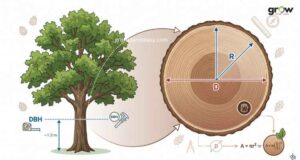
📐 How Is Basal Area Calculated?
For a single tree, basal area is the area of a circle formed by the trunk’s cross-section.
The basic formula is:
Basal Area = π × (DBH ÷ 2)²
When DBH is measured in inches, it must first be converted to feet if the desired result is in square feet.
For example, consider a tree with a 20-inch DBH.
First convert:
20 ÷ 12 = 1.67 feet
Then calculate the area of the trunk cross-section.
The resulting basal area is approximately 2.18 square feet.
Also check: Tree Height Calculator & Plants Per Sq Ft Calculator
🌲 What Is DBH?
DBH stands for Diameter at Breast Height.
It is a standardized way of measuring tree diameter so that trees can be compared consistently.
In many forestry applications, DBH is measured at approximately 4.5 feet (1.37 m) above ground level.
This is important because tree trunks are usually wider near their base. Using a standard height makes measurements more consistent.
📊 Single Tree vs. Stand Basal Area
These two measurements shouldn’t be confused.
| Measurement | What It Describes |
|---|---|
| Single-tree basal area | Cross-sectional area of one tree trunk |
| Stand basal area | Combined tree basal area within a defined area |
| DBH | Diameter of a tree measured at breast height |
| Trees per acre | Number of trees occupying one acre |
| Basal area per acre | Stand basal area expressed per acre |
A single tree may have a basal area of only a few square feet, while a mature forest stand can have a much larger total basal area per acre.
❓ FAQs – Basal Area Calculator
1. What is basal area in forestry?
Basal area is the cross-sectional area of a tree trunk measured at a standard height, usually based on DBH. For a forest stand, it represents the combined basal area of trees within a defined area.
2. What is the formula for basal area?
The basic formula is:
Basal Area = π × (DBH ÷ 2)²
Make sure the diameter is in the appropriate unit before calculating the area.
3. What is DBH?
DBH means Diameter at Breast Height. It is commonly measured at approximately 4.5 feet above the ground.
4. How do I calculate basal area per acre?
Calculate the basal area of the individual trees and add them together for the trees in the acre. A simplified estimate can use average tree basal area multiplied by trees per acre.
5. What units are used for basal area?
Individual tree basal area can be expressed in square feet or square meters. Forest stand basal area is often expressed as square feet per acre in the United States.
6. Does a larger tree always have a larger basal area?
Yes, assuming the trunk is approximately circular. Basal area increases as the tree’s diameter increases.
🌲 Conclusion
The Basal Area Calculator provides a quick way to understand one of the most useful measurements in forestry.
By entering a tree’s DBH, you can estimate its individual basal area. For a group of trees, you can also use average DBH and tree density to get a simplified estimate of basal area per acre.
Remember that accurate forest assessment requires careful field measurements and appropriate sampling methods. But for learning, planning, and basic tree comparisons, this calculator makes basal-area calculations much easier. 🌲📏