
🌱 Turf Infill Calculator
Installing artificial grass requires the right amount of infill to help support the turf fibers and improve overall performance. Our Turf Infill Calculator estimates how much infill you need based on the turf area, application rate, bag weight, and extra allowance. It also calculates the number of bags required and your estimated material cost.
Simply enter your turf measurements and project details to get a quick estimate. You can also explore our easy landscaping and artificial turf calculators for planning other outdoor projects.
📐 How to Use the Turf Infill Calculator
Using the calculator is simple:
- Enter the length and width of your artificial turf area.
- Select feet or meters.
- Choose your turf application and infill rate.
- Select an extra allowance for the project.
- Enter the weight of one infill bag.
- Optionally enter the cost per bag.
- Click Calculate Turf Infill.
The calculator will estimate your total infill weight, number of bags, coverage per bag, purchased weight, and material cost.
Check: Artificial Turf Cost Calculator & Mango Tree Watering Calculator
🧮 How Is Turf Infill Calculated?
First, the calculator determines your artificial turf area:
Turf Area = Length × Width
The area is then multiplied by the selected infill application rate in pounds per square foot.
For example, if you have 500 square feet of turf and use an application rate of 1.5 lb per square foot, the base requirement would be approximately 750 lb of infill.
An optional extra allowance is then added before calculating how many full bags you need to purchase.
📊 Artificial Turf Infill Rate Guide
Different artificial turf projects may require different amounts of infill.
| Turf Application | Example Infill Rate |
|---|---|
| Light Landscape Turf | 1 lb/sq ft |
| Standard Landscape Turf | 1.5 lb/sq ft |
| Heavy Landscape / Pet Turf | 2 lb/sq ft |
| Playground / High Traffic | 2.5 lb/sq ft |
| Sports / Heavy-Duty Turf | 3 lb/sq ft |
These are general planning estimates. Always check the recommendations provided by your artificial turf and infill manufacturer before installation.
Check: Palm Tree Trimming Cost Calculator & Sprinkler Water Usage Calculator
🛍️ How Many Bags of Turf Infill Do I Need?
Once the total required weight is calculated, the calculator divides that amount by your infill bag weight and rounds up to the next full bag.
For example:
| Infill Needed | Bag Size | Bags to Buy |
|---|---|---|
| 500 lb | 50 lb | 10 bags |
| 750 lb | 50 lb | 15 bags |
| 1,000 lb | 50 lb | 20 bags |
| 1,250 lb | 50 lb | 25 bags |
Buying full bags ensures you have enough material to complete the installation.
❓ Turf Infill Calculator FAQs
1. What is artificial turf infill?
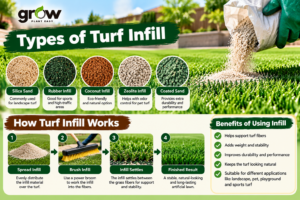
Artificial turf infill is material distributed between synthetic grass fibers. Depending on the turf system, it can help support the blades, add weight and stability, and contribute to the performance of the finished surface.
2. How much infill do I need for artificial turf?
The amount depends on turf area, pile height, turf type, infill material, and manufacturer recommendations. Enter your area and application rate into the calculator to estimate the total weight required.
3. How do I calculate turf infill?
Multiply the turf area in square feet by the recommended pounds of infill per square foot. Add any desired extra allowance, then divide the total weight by the bag size to determine how many bags to purchase.
4. How many bags of infill do I need?
Divide your total required infill weight by the weight of one bag and round up to the nearest whole bag. The calculator does this automatically.
5. Does pet turf need more infill?
Pet turf can have different infill requirements depending on the turf system and the type of infill used. Some installations use specialized infill designed for drainage or odor management, so follow the product manufacturer’s instructions.
🌱 Final Thoughts
The Turf Infill Calculator makes it easy to estimate how much artificial grass infill your project may require.
Enter your turf dimensions, infill rate, bag size, and extra allowance to calculate total pounds, bags needed, coverage, and estimated cost. For the most accurate installation, compare the result with the recommended infill rate for your specific artificial turf product.